

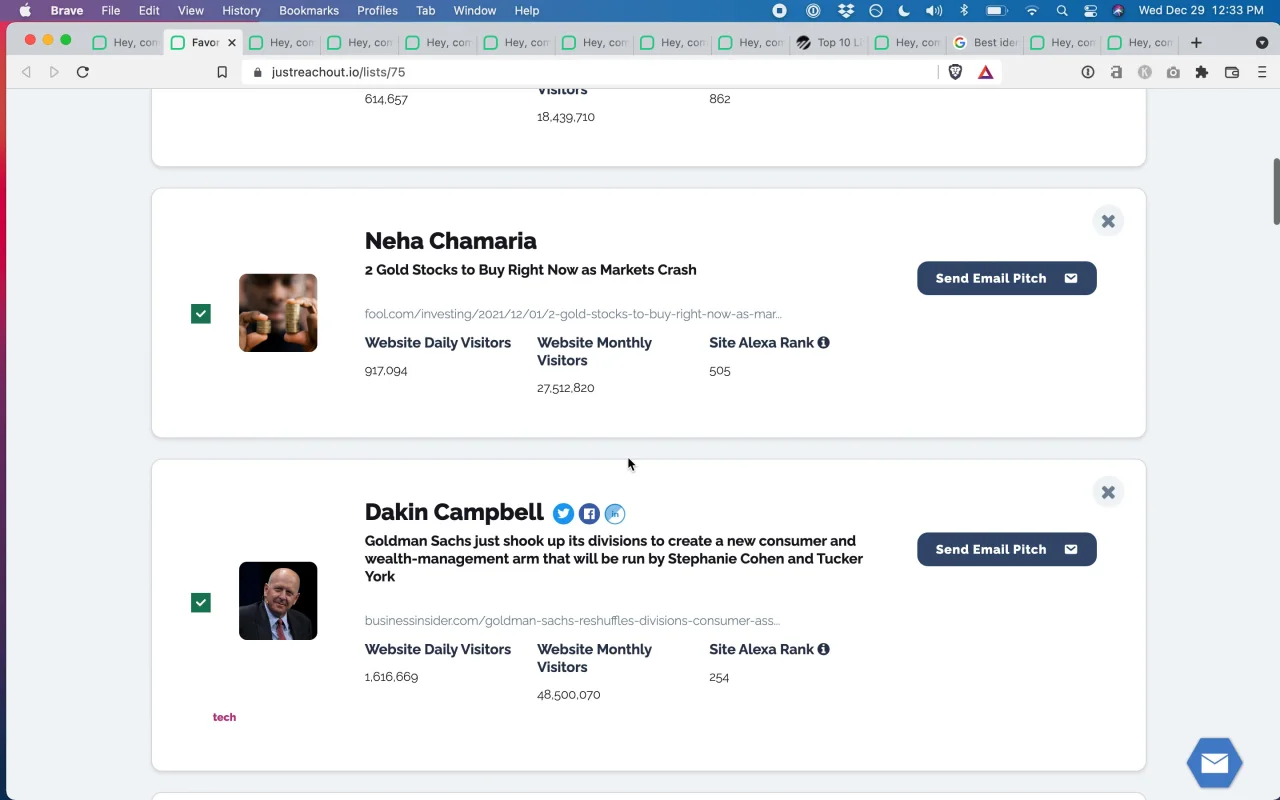


HARO is still around in 2026 as a free email digest sent up to three times on weekdays. The harder question is what you need from an alternative. Are you waiting for a reporter to ask for your expertise, or do you already have a story worth taking to a reporter? For the first job, look at Qwoted, Source of Sources, Connectively, or SourceBottle. For the second, JustReachOut gives a small team a way to find relevant journalists and build its own outreach workflow.
I would keep a request feed in the mix even if I were pitching directly. It catches deadlines you could not have planned for. But I would not build a PR strategy around refreshing an inbox and hoping a query happens to match my company this week.
| ⚠ IMAGE Featured screenshot for the article, labeled ‘haro-alternatives’. Retain the existing asset. |
|---|
| ⚠ IMAGE Video embed (Wistia): ‘JustReachOut Walkthrough’. Retain the existing product demo. |
The best HARO alternatives at a glance
| Tool | Best for | How it works | Pricing approach |
|---|---|---|---|
| JustReachOut | Small teams doing proactive PR and source-request outreach | Journalist search, pitch workflows, source requests, podcast outreach | Paid plans; check current pricing |
| Qwoted | Experts who want matched reporter requests | Expert profiles, media requests, direct messaging | Free plan; Pro listed at $149/month |
| Source of Sources | A simple, free journalist-query email | Email digest of reporter requests | Free |
| Connectively | Searching and tracking source requests in a platform | Opportunity search, keyword alerts, answer tracking | Free plan; paid tiers |
| Featured | AI-assisted discovery across PR opportunities | Chat-based search for requests, journalists, podcasts, and more | Free plan; paid tiers |
| SourceBottle | Topic- and country-filtered source calls | Email alerts and online responses | Free source alerts |
| ResponseSource | UK-focused media enquiries | Category-based journalist enquiry service | Annual category subscriptions |
| Muck Rack | Media lists, pitching, and reporting | Journalist database and PR workflow platform | Contact sales |
| Meltwater | Monitoring and media intelligence | Coverage tracking, media relations, and analytics | Custom quote |
| CisionOne | Larger PR teams managing outreach and monitoring | Media contacts, outreach, monitoring, and reporting | Custom quote |
How I compared them: I grouped these tools by the job they help you do: answer a request, initiate a pitch, or monitor coverage. Features and prices come from the linked provider pages, reviewed in October 2026. This is a desk-researched guide, not a hands-on test or a ranking of placement rates. Verify plan limits and availability before you buy.
1. JustReachOut: Best for pitching journalists directly
A source-request feed only shows stories a journalist has already decided to work on. What if you have a useful story that nobody has requested yet? That’s where JustReachOut earns its place at the top of this list.
You can look for journalists who cover your topic, review relevant opportunities, find podcasts to pitch, and manage outreach in one workflow. Its journalist request tool also brings requests from multiple sources into a searchable hub. Plans include pitch templates and contact information, with more hands-on support available in higher tiers. This is particularly useful when you’re a founder or marketer doing PR without an agency and you need a repeatable way to find the right people.
Best fit: A startup or small business that wants to respond to requests and pitch its own stories. Consider another option if: You only need a free email of reporter queries. See JustReachOut’s plans for current pricing and limits.
2. Qwoted: Best for building a searchable expert profile
Qwoted lets experts and PR teams create profiles, receive relevant media opportunities, and communicate with journalists through the platform. If you have a founder, technical specialist, or clinician with clear credentials, a complete profile makes it easier for reporters to assess whether that person can help.
Best fit: Experts who can answer specific questions quickly and want a profile reporters can find. Watch for: Usage limits on the free tier. Qwoted lists two pitches per month and a two-hour response delay on Basic; Pro is listed at $149/month with 35 pitches per month.
3. Source of Sources: Best free email alternative
Created by HARO founder Peter Shankman, Source of Sources sends journalist queries by email up to three times a day. You read the requests and reply directly when your expertise matches. The service says it is free and explicitly warns against off-topic pitches.
Best fit: Someone who likes HARO’s straightforward email format and can scan requests regularly. Watch for: You’ll still need to sort through the inbox and meet the reporter’s deadline yourself.
4. Connectively: Best for managing queries inside a platform
Connectively returned in 2026 as a platform-based companion to HARO’s email newsletter. It lets you find opportunities, set alerts, submit answers, and track what you sent. Its Opportunities feature also points to requests from external sources; for those, you follow the link and pitch through the original channel.
Best fit: A source who wants filtering and a record of responses instead of another digest to scan. Watch for: Free-plan submission limits. The published pricing page lists three answers per month on Free, with higher limits on paid plans.
5. Featured: Best for AI-assisted PR discovery
Featured offers a chat-based PR assistant for finding journalist requests, relevant reporters, podcasts, byline opportunities, and other PR leads. Its journalist request feature brings requests from sources including HARO and Connectively into one workflow. That overlaps with Connectively, so compare the two based on whether you mainly want a query dashboard or broader AI-assisted discovery.
Best fit: A team exploring several kinds of PR opportunities through one interface. Watch for: AI can help draft a response, but your facts, expertise, and final wording still need a human check. Featured’s pricing lists a free plan and paid tiers with different usage allowances.
6. SourceBottle: Best for filtering requests by topic and country
SourceBottle connects journalists, writers, and bloggers with people who can answer their calls for sources. You can choose the topics and countries you want to hear about, receive matching email alerts, and respond online. Source alerts are free, according to SourceBottle’s service description.
Best fit: A business whose expertise fits the available topics and geographies. Watch for: The value depends on whether relevant requests appear in your chosen categories, so review the calls before making it a core channel.
7. ResponseSource: Best for UK media opportunities
ResponseSource helps journalists seek experts, case studies, images, and other material for editorial work. For PR teams focused on UK coverage, its category-based Journalist Enquiry Service pricing is worth comparing with a broader international tool. The site lists annual subscriptions starting at £625 per category.
Best fit: A UK-focused team with a specific subject area. Watch for: The subscription structure may be harder to justify if you only need occasional enquiries outside the UK.
8. Muck Rack: Best for a full media-relations workflow
Muck Rack combines a media database with list building, pitching, monitoring, and reporting. It is a different kind of HARO alternative: you use it to research and contact journalists, as well as track the work that follows, rather than simply reading incoming source requests.
Best fit: PR teams and agencies that need shared lists and reporting. Watch for: Muck Rack asks prospective buyers to contact sales for plan pricing, so request a quote for the exact features your team will use.
9. Meltwater: Best for monitoring coverage at scale
Meltwater offers media intelligence, media relations, social listening, and reporting across plans designed for different team sizes. It makes more sense when understanding coverage and reporting results is as important as finding the next journalist to pitch.
Best fit: A communications team that needs ongoing monitoring across channels or markets. Watch for: Meltwater says its pricing varies by capabilities, coverage, and contract terms; get a tailored quote rather than relying on an old starting price.
10. CisionOne: Best for established PR teams
CisionOne offers journalist outreach, media monitoring, and reporting in several solution packages. If your team has to maintain media lists, track coverage across channels, and show stakeholders what happened, it deserves a look.
Best fit: An established team that needs a broader PR system. Watch for: Cision provides pricing through consultation, and the package you choose matters. Ask which outreach, monitoring, and distribution capabilities are included in the quote.
Which HARO alternative should you choose?
Start with the story you can actually offer. A source-request service is useful when someone on your team can answer a journalist’s specific question before the deadline. A journalist-search tool is useful when you have an angle of your own and can explain why a particular reporter’s readers would care. Monitoring software earns its budget when you need to keep tabs on coverage and report on it across a team.
Here is how that plays out. Imagine a founder who has analyzed anonymized support tickets and spotted a sharp rise in a customer problem. If a reporter asks about that exact problem, Source of Sources or Connectively could surface the request. If no one is asking yet, JustReachOut is the more natural place to find reporters who have covered the issue and pitch the finding, including how the data was gathered and what it can and cannot show. That is an illustrative scenario, not a claim that either approach will secure coverage.
A quick way to decide whether a request is worth your time: Can you name the person who should answer it? Can they provide a specific example or data point? Can they respond before the deadline? If any answer is no, skip it. For a direct pitch, swap the deadline question for this one: Can you point to a recent article that shows why this reporter is a fit?
On a tight budget, start with Source of Sources; add SourceBottle if its categories and countries match your expertise. Compare Qwoted and Connectively if you want a profile or a workspace for requests. Try Featured if you also want to explore podcasts and other opportunity types. Consider ResponseSource for UK-focused enquiries. Muck Rack, Meltwater, and CisionOne make more sense when shared media lists, monitoring, or reporting are requirements you can name. Social posts tagged #journorequest can provide extra leads, but verify the journalist, outlet, deadline, and response method yourself.
For two weeks, log each relevant request or direct pitch, the minutes spent, the reply, and any resulting interview or coverage. This will tell you which workflow produces useful conversations for your business. A placement or backlink is never guaranteed.
Frequently asked questions
Is HARO still active in 2026?
Yes. HARO says it sends free journalist-query digests up to three times a day on weekdays. Connectively is a separate platform experience under the same ownership.
Are any HARO alternatives free?
Yes. Source of Sources and SourceBottle offer free source alerts. Qwoted, Connectively, and Featured have free plans with limits. Compare those limits against how many useful requests you expect to answer, rather than choosing on price alone.
Can I use HARO and an alternative together?
Yes. Keep HARO or another query service for stories in progress, then use a direct-outreach tool when you have a timely idea to pitch. Avoid sending the same generic message to every journalist you find.




Solid research. I do find you have to get pretty lucky with journalist queries to get quoted, proactive PR is definitely the way to go.
I have seen “#journorequests” on twitter from time to time, but had no idea what it really meant or what it was used for. I wish I would have known sooner because I probably missed out on some serious PR opportunities. I’m glad to finally be aware of the wide range of tools that are available for press coverage.
Yes, there are a lot of these types of sites, emails, tweets, it’s a good idea to keep track of them and answer these. JournoRequests has been around for a while.
I never knew there were so many tools to search for journalists on the web. A friend has asked me for a PR referral to get some activity at her jewelry store opening.
I didn’t even know where to begin and stumbled across your article while googling. Hopefully, my friend and I can put together a strategy with some of your tools and a few from this list and get her event some much-needed press.
Great post!
Glad to hear this list was useful Daniell. Holler if you have any questions trying to use some of these tools!
Hi I really like this article, thanks a lot for good information as I am always looking for ways to enhance my seo skills.