

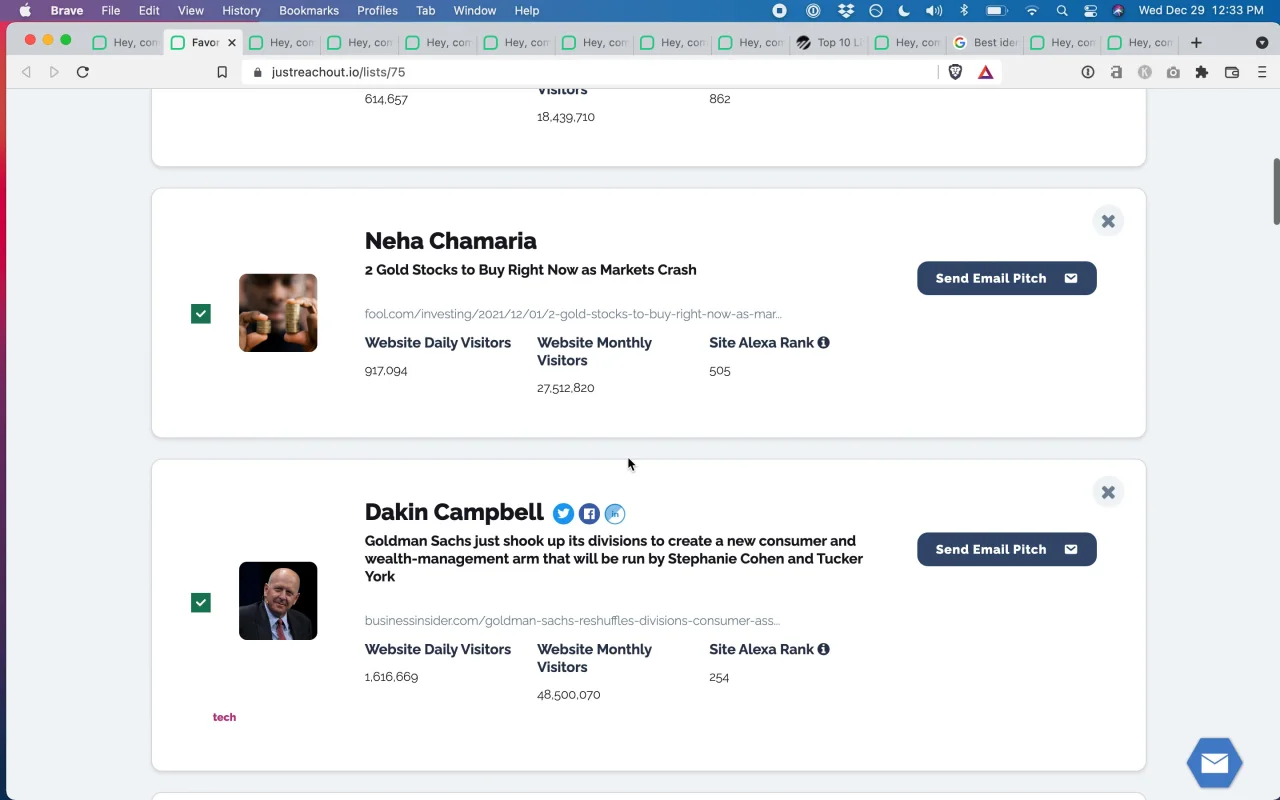


Neil Napier, founder of JobRack, wanted press coverage without committing to an agency retainer. He estimated that an agency could cost around $5,000 a month for roughly five stories. So he tried a more focused approach: find journalists already looking for sources, answer requests he could genuinely help with, and use Just Reach Out to search for relevant press opportunities.
The short answer: Neil reported placements on two sites with Domain Authority scores above 70 within his first week using the approach. His experience shows what a small team can do with timely, useful pitches. It does not mean every request will turn into coverage or a backlink.
What are journalist requests, and where does HARO fit in?
A journalist request is a call for a source, quote, example, or interview for a story in progress. Help a Reporter Out (HARO) is one way to find those calls. Journalists submit questions with deadlines; sources reply if they have relevant experience.
HARO has changed since Neil’s original case study. After an interruption and change of ownership, the HARO newsletter returned in 2025. Its current description says sources can sign up for free at helpareporter.com and receive up to three email digests per weekday. You can scan those emails for relevant requests and respond using the instructions in each query.
That inbox workflow gets crowded fast. Just Reach Out’s journalist pitch requests tool brings opportunities from multiple sources into one place and lets you search by keyword or category. Check the source, deadline, and response instructions on each opportunity before sending a pitch. The screenshots below show Neil’s original workflow; interfaces and delivery methods may have changed since then.
How did JobRack find press opportunities worth pitching?
Neil searched for topics connected to JobRack’s current campaigns. He did not wait for a request containing the perfect keyword. If a journalist needed firsthand insight that he could provide, the request was worth a closer look.
Here’s a practical way to repeat that process:
- List your credible topics. Write down the problems your team has solved, the data you can explain, and the experiences your founder can speak to firsthand.
- Search and filter. Look through journalist requests in Just Reach Out by topic or keyword. If you also use HARO emails, scan for requests that match those same areas of expertise.
- Read the entire query. Check the publication, source requirements, deadline, and requested response format. Skip anything where you would have to stretch your credentials.
- Answer while the request is open. Lead with a useful observation or example. A journalist on deadline should not have to hunt for your point.
What did Neil put in his pitch?
Neil kept his replies short. He addressed the journalist by name, gave a quick reason he was qualified, and shared his actual answer in four to eight scannable lines. He also included more than one way to reach him. One example in the original case study responded to a request about WordPress entrepreneurs; the article shows a resulting feature on WpCeoBlogNation.com.
You can use this structure as a starting point, then adapt it to the query:
Hi [journalist name],
I saw your request about [specific topic]. I’m [name], [role] at [company], where I’ve [relevant firsthand experience].
Here’s the point I’d offer for your story: [one clear, specific answer].
- [Brief example or supporting detail]
- [Another detail, if the query calls for it]
Happy to clarify or speak before [deadline]. You can reach me at [email] or [other contact method].
[Name]
Treat that as a framework, not a script to send unchanged. If the journalist asks for a single paragraph, a particular credential, or a specific type of source, follow those instructions instead.
What results did JobRack report?
Neil reported features on two sites with Domain Authority scores above 70 in the first week. He also valued the time saved by filtering for relevant requests and the relationships he began building with journalists. Those are the case study’s reported results, not a forecast for a new campaign. Domain Authority is a third-party metric, and a high score alone cannot tell you whether a placement drove qualified traffic or improved rankings.
Do journalist-request placements help SEO?
They can. A relevant editorial mention may earn a link, introduce your company to readers, and send referral traffic. A journalist might also quote you without linking, so do not treat a reply or even a published mention as a guaranteed backlink. The strongest reason to pitch is that your experience makes the story better. If a link follows, evaluate it alongside the publication’s relevance, referral traffic, and the relationships it helps you build.
Neil’s rule still holds up: be useful, be selective, and respect the journalist’s deadline. For a small team, searching press opportunities with Just Reach Out is a manageable place to start. Pick a few requests you can answer well this week and measure the coverage you actually earn.




Great detailed post on how to use HARO. I know it works because I have been using it for some time now with good results.
Love the post Dmitry. What other tools would you recommend for a startup building its own media relations?
Nice! There are many tools that you can use to find relevant media contacts and improve outreach. Here’s a link to the best PR tools: https://justreachout.io/blog/pr-tools/
Great read Niel and Dmitry. Good start here!
Thanks Robert. Appreciate!