



How to Improve Your PR Outreach?
Now that you know what PR outreach is and why it is important, let’s figure out how to make it flawless.
In 2026, personalized and targeted outreach works best for earning media coverage. To get noticed in a crowded inbox, you need a surgical approach.
Here are 5 verified steps to improve your press outreach:
1. Know your target audience
In this case, your audience is the journalist or blogger. Research media outlets (publications, magazines, blogs) and the specific individuals you plan to reach out to. Don’t just skim their latest headline. Read as many articles as possible. Check their LinkedIn or X (formerly Twitter) to see what they are currently debating.
This allows you to understand the narrative they are building. I can’t emphasize this enough: The pitches that consistently earn replies are the ones where the story fits precisely what the journalist covers. Be absolutely certain your story fits their beat before hitting send.
2. Build your specific media list
Pitching the right story to the right person is how you turn a cold email into a genuine media opportunity. Use these 5 steps to ensure your media list is rock-solid:
- Step 1: Define the Content You’re Pitching. Are you offering an executive interview, a product launch, or original data? Your list depends entirely on the “what.” Each content type attracts a different kind of journalist, so get specific before you start building.
- Step 2: Develop Unique Angles. Develop different “hooks” for different journalists. A tech writer wants the “how it works,” while a business editor wants the “market impact.” The same story can generate multiple placements if you tailor the angle for each outlet.
- Step 3: Decide the Timing. Is your story “breaking” or “evergreen”? Online outlets need stories today; monthly magazines plan 3–6 months in advance. Matching your pitch to a publication’s editorial calendar dramatically increases your chances of a “yes.”
- Step 4: Search by Publication and Writer. Use a tool like JustReachOut to find writers who have used your specific keywords in the last 60 days. This ensures they are still active on the topic and not just a name on an old masthead.
- Step 5: Focus on Correct Designations. Look for staff writers, reporters, or contributors, these are the people who actually assign and write stories. Never pitch the Editor-in-Chief directly. They manage the publication, not the individual stories.
3. Write an attention-grabbing subject line
Your subject line is your gatekeeper. Industry data reveals a brutal truth about modern inboxes: half of all journalists and editors are inundated with up to 50 pitches per week, while the other half routinely receive anywhere from 50 to over 151 weekly pitches (Cutting Edge PR). Yours needs to stand out in 3 seconds.
Here’s the deal: Keep it short, sweet, and curious. Avoid “clickbait” but use personalization. Research shows that personalization alone can increase open rates by up to 50%, while subject lines in the 61–70 character range consistently outperform shorter and longer alternatives (Ronn Torossian / Medium). A/B test your subject lines if you’re doing a larger campaign to see what resonates.
4. Develop your relevant story
A good pitch outlines a story, not just a product. Keep the body between 200–300 words. Think like a headline writer: what is the key message? Provide the “why now?” and a quick bulleted list of emotional or data-driven insights. If you’re offering an exclusive, mention it clearly at the top, journalists love being the first to break a story.
5. Prove your content’s value
Why does this matter to their readers? Your pitch must exemplify three qualities:
- Credible: Back every claim with a data source or your own credentials. Journalists need to be able to verify what you’re telling them before they stake their byline on it.
- Newsworthy: Tie your story to a trending topic, a timely data point, or a specific local event. If it could have been written six months ago and published six months from now, it is not newsworthy enough.
- Relevant: Show explicitly how your story will educate, entertain, or inspire their specific audience. Don’t make the journalist do the connecting — do it for them.
What do journalists and bloggers want in a pitch?
To win at PR, you have to think like a journalist. The dynamic between PR practitioners and news staff remains starkly unbalanced. According to the U.S. Bureau of Labor Statistics, there are approximately 315,900 public relations specialists currently employed in the U.S. (BLS). When compared against a shrinking core of news reporters, journalists, and correspondents, PR professionals vastly outnumber newsrooms. To make matters worse for incoming pitches, the BLS projects that public relations roles will continue expanding at a faster-than-average pace of 5% over the next decade (BLS).
The journalists who respond are the ones who receive pitches that feel written specifically for them. To earn that reply, you need to provide what they actually need.
1. Journalists want to collaborate on stories
According to Cision’s 2026 State of the Media Report, which surveyed nearly 2,000 journalists worldwide, 66% of journalists openly state that they rely on PR-provided content, including targeted pitches, media kits, and press releases, to formulate their daily story ideas (Cision / PR Newswire). They want genuine collaboration, not a finished article dropped in their inbox.
- Takeaway: Don’t send a final 1,000-word draft. Send a rough outline and ask, “Would you like to explore this angle together?”
2. Journalists want exclusive research
Exclusivity is the gold standard. According to Cision’s 2025 State of the Media Report, based on a survey of over 3,000 journalists, 57% of reporters say they want exclusive story access, and 55% explicitly value original research such as market data and proprietary findings (Cision). If you have proprietary research or original data no one else has, that is your biggest competitive advantage.
The resulting article is one of OKDork’s most popular pages with backlinks from over 1,200 domains.
3. Journalists want high-quality articles and visualizations
Visuals aren’t just “nice to have” anymore, they are essential. Content creators are looking for infographics, data visualizations, and high-res images that make the story “scroll-stopping.” According to Cision’s 2025 State of the Media Report, most journalists used PR-provided multimedia elements in their coverage last year, and 72% of reporters named press releases as the most useful resource PR teams can offer, with impact increasing significantly when paired with visual assets (Cision). If you can attach a compelling visual asset to your pitch, you are giving the journalist a reason to open the conversation.
4. Journalists want you to create a connection with them before pitching
Whose email would you open: a stranger’s or someone who regularly interacts with your work?
The process:
- Comment thoughtfully on 2 of their recent articles.
- Follow and engage with them on LinkedIn or X.
- Share their work with your own audience.
Then, and only then, send the pitch. By the time your email lands, you’re no longer a cold contact. Cision’s 2025 State of the Media Report found that 86% of journalists say they will immediately reject a pitch that isn’t aligned with their beat or audience, which is why relevance and familiarity together are what earn the reply (Cision).
5. Journalists want you to pitch over email
Forget DMs or phone calls. According to Cision’s 2025 State of the Media Report, 84% of journalists say the best way to build a relationship is simply to introduce yourself via email, even without a story to pitch yet (Cision). Email is non-intrusive, searchable, and easy for them to act on at their own pace. It also shows you respect their time and understand how their workflow actually operates.
6. Journalists want to see catchy subject lines
As noted, subject lines are make-or-break for PR outreach. Analysis of millions of PR emails shows that subject lines between 61–70 characters achieve a 32.1% open rate, and that personalization can lift open rates by up to 50% (Ronn Torossian / Medium). A simple “[Data Study] The Real Reason SaaS Churn is Rising” is often more effective than something overly clever. Lead with the value, keep it short, and skip the exclamation points.
7. Journalists want to see short pitches
The PR pitch is not the place to write your next magnum opus. Get to the point, respect the journalist’s time, and leave them wanting to know more. Research consistently shows that brevity wins: shorter pitches dramatically outperform long-winded ones, between 100 and 300 words is the sweet spot most reporters prefer (Cision).
It’s also important to keep your formatting readable. No lengthy paragraphs, no walls of text, no poor spacing. Make it easy to scan in under 30 seconds.
What is a perfect pitch?
The perfect pitch is a “mutually beneficial ask.” You are providing value (news, data, or insight) in exchange for exposure.
Key components of the perfect pitch:
- Short, personalized body (under 150 words).
- Intriguing, simple subject line.
- Direct address by name (no “Hi Team”).
- Clear “why it matters” section.
- Zero buzzwords or marketing fluff.
PR outreach email templates
Actual templates always beat general advice. Here is a battle-tested classic. For a deeper look at what makes each format work, see JRO’s full guide to PR pitch templates.
Real result: One JRO user, a bootstrapped SaaS founder with zero prior PR experience, landed a feature in a well-known business publication within their first 45 days on the platform. They used JRO’s journalist request feature to find a reporter actively seeking expert commentary on their topic, sent a 175-word pitch, and had a reply in their inbox within 18 hours.
Their words: “I replaced a $2,500/month PR agency retainer. I had no idea this was even possible on my own.” (Paraphrased from a verified user review on G2).
1. The “Spelling Mistake” / Helpful Feedback Email
This is the ultimate “give before you ask” strategy.
Subject: Quick note on your [Article Title] piece
Hi [Name],
Really enjoyed your recent article on [Topic]. I noticed a small typo in the third paragraph (it says ‘[Error]’ instead of ‘[Correction]’). Just wanted to let you know so you could fix it!
On another note, I’ve been working on some data regarding [Related Topic] that might be a great follow-up for your readers. Would you be open to seeing a quick outline?
Best,
[Your Name]
Why it works: You’ve actually read their work and provided immediate value before asking for anything. That one small act of generosity sets you apart from the massive sea of irrelevant, cold pitches filling their digital mailboxes.
2. The “upcoming news” email
Journalists love a scoop, especially if they can get it before others. This template uses the journalist’s recent work as an ice-breaker and connects it to something you’re doing at your business.
- Refer to a recent article published in the past 3 months.
- Reference the journalist’s article by name so they know you actually read their work. This immediately signals that your pitch is targeted, not mass-blasted.
- Mention a recent accomplishment or milestone. Share something specific about your business, a funding round, a product launch, a notable customer win, as social proof that you are worth paying attention to.
- Tease upcoming news and hint at exclusivity. Let the journalist know something bigger is coming and that you thought of them first.
- Close with a casual, low-pressure note that makes a reply feel easy.
3. The “helpful article” email
Your target journalist just wrote an in-depth article on a topic. There’s a good chance they are interested in learning more about it, or finding a fresh angle for a follow-up. This email focuses on sharing relevant content with the journalist as a way to kickstart the conversation.
- Open with a common reference: If you share a mutual contact, name-drop them early; a familiar name in the opening line will almost always keep your email out of the trash. If you don’t have a contact, a specific and genuine observation works just as well.
- Link to the article: It’s always a good idea to link to the actual content you’re referencing. Journalists write a lot and might not always remember the specific piece.
- Share genuinely useful content: Link to something that adds real value for the journalist’s audience. The goal here is to start a conversation, not to acquire a backlink.
4. The “followed your advice” email
If you’ve tried something a blogger wrote about and got good results from it, let them know. Writers love nothing more than knowing that their writing has had an actual impact on people. This template does have limited use cases; you can only send it to people whose advice you’ve actually followed.
- Mention a specific time frame: Saying “I’ve followed your column for about two years” sounds far more genuine than “I’ve been a long-time reader.” Specificity signals authenticity.
- Share exact results: Describe precisely what effect following the advice had on your business or life. If you can offer documented proof, a screenshot or a stat, the writer will appreciate it even more.
- Reference your own related content: Share a post or resource that builds on the writer’s original advice, especially if you can include data or documented results that prove the approach worked.
5. The infographic outreach email
“Infographic” is used loosely here; you can use this email to share articles, eBooks, original data, or even news stories.
- Reference the article by name, not just its URL: Spammers paste links, humans mention the actual piece. Naming the article signals that you read it and immediately separates you from mass outreach.
- Call out something specific from the article: A single concrete observation, a surprising stat, a counterintuitive argument, a well-phrased point, is enough to show genuine engagement. Generic praise like “loved the article” does not count.
- Ask before sharing the asset: Do not drop the infographic link in the first email. Ask for permission to share it. This one step alone sets you apart from the bulk-blast crowd and dramatically improves your reply rate.
6. The exclusive data email
Remember the data results which showed that journalists actively look forward to original, exclusive metrics? This template is built entirely around that core insight.
- Lead with your knowledge of their beat: Tell the journalist you follow their work and understand their coverage area. Keep it brief — two sentences max — then get straight to the point.
- Summarize your research in plain language: You do not need to attach a heavy whitepaper. Two or three sentences explaining what you studied, how many people you surveyed, and what the headline finding was is enough to earn a reply.
Armed with these templates, you are ready to tackle pretty much any PR outreach challenge. The key is to pick the format that fits your situation and personalize it, every time, without exception.
How to end your email pitches
An interesting sign-off will leave a favorable impression on your recipient and can meaningfully increase your chances of a response. Avoid generic closings like “Best” or “Thanks” on their own. Add a single specific line before the sign-off that reinforces your ask or makes the next step obvious.
How to find journalists to pitch
You now know what journalists want in a pitch. You also know the basics of how to write the perfect pitch email with an impressive sign-off. But the fundamental question remains: How do you actually find journalists to pitch?
Before you can do that, however, you need to figure out your target “beats.”
Figuring out who to pitch
Journalists usually specialize in “beats”, areas of focused coverage built up over years of reporting. A journalist working a particular beat (such as local municipal politics) usually has deep experience and trusted sources in that specialty. The breadth of the beat depends on the size of the media company. A large newspaper like the NYT might have separate reporters for local, minor league, and major league baseball. A smaller outlet might have just one journalist covering sports as a whole.
Bottom line? When you start your journalist research, it’s important to understand what beat your story belongs to and how broadly it can be framed. For instance, if you’re running a chatbot startup such as Intercom, you might find that very few journalists specifically cover chatbots. There are, however, plenty writing about customer service startups, AI, and SaaS, all adjacent beats where your story fits naturally.
Try to target different beats based on your business’:
- Target market: Which businesses or consumers does your product serve — small businesses, eCommerce owners, enterprise teams? Publications that write about those markets are natural targets for your pitch.
- Platform: Does your product live on a specific platform — Android, iOS, Shopify, Salesforce? Platform-specific publications have highly engaged audiences who are already invested in that ecosystem.
- Business size: Some outlets cover only bootstrapped startups; others focus exclusively on funded or enterprise companies. Knowing which tier you belong to helps you pitch the right publications.
- Technology: Are you using AI, machine learning, augmented reality, or another emerging technology in your product? Tech-focused journalists actively seek out companies building in these spaces.
- Problem: What pain does your product solve? A customer service automation tool, for instance, is a natural fit for journalists covering CX, SaaS, or workforce productivity — not just “tech.”
- Competitors: Publications that have already covered your competitors are perfect targets for a pitch. They have demonstrated interest in your space and are far more likely to respond to a well-framed pitch.
Do this and you’ll greatly expand your list of prospects. Your next step is to make a list of target journalists.
Finding the right journalists
There are three approaches to finding journalists.
Approach #1: Manually make a list of journalists
This is the slow, old-school way to find journalists and bloggers, but it works, and it’s free. You search for relevant publications in your industry, then dig through their sites until you find journalists who cover your beat.
Start by identifying your target beats (see above), then search for publications in each one. Use queries like these:
"[niche] blog""[niche] news"
For better results, try more complex search parameters:
[niche] + intitle:blog/url – intitle:forum -site:youtube.com
Plug each journalist’s name into your spreadsheet and repeat this process for all the sites you found during your research. It’s time-consuming, but it filters out a lot of incorrect leads.
Approach #2: Using a PR outreach tool
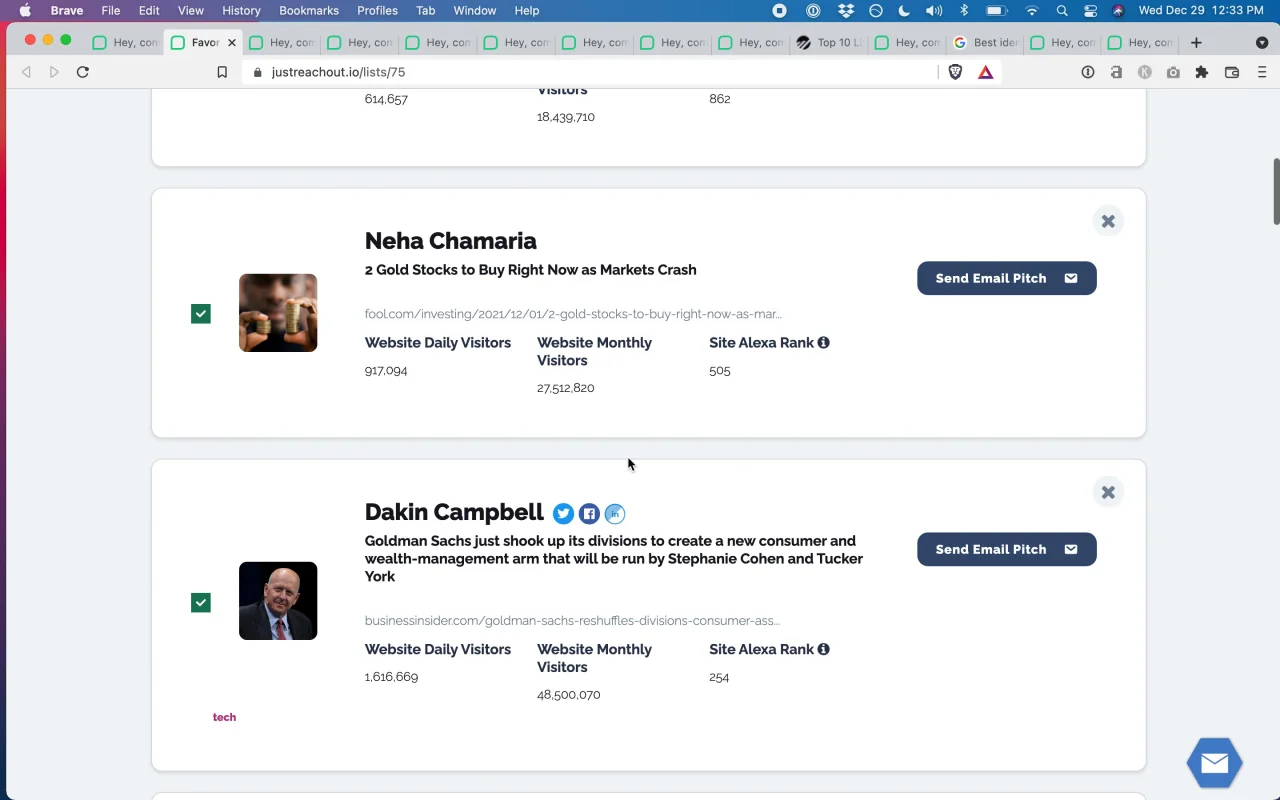
Thankfully, there are tools that will automate the research process for you and cut the manual work down to minutes. For example, if you’re using JustReachOut, you can simply plug in your target beat into the search box and immediately see a list of journalists who have written about that topic recently. Instead of building a separate spreadsheet from scratch, just hit the star icon to add each journalist to your favorites list.
Approach #3: Use your competitors’ links
This tactic works great if you have well-established competitors who’ve received a lot of press. Your goal is to find journalists and bloggers who have linked to or mentioned your competitor, then approach them with your pitch.
There are two ways to do this:
- By digging through your competitor’s backlinks and finding relevant publications.
- By searching on Google.
For the first tactic, you’ll need a backlink research tool such as Ahrefs. Plug your competitor’s URL into Ahrefs and click on “Backlinks” to see all the sites linking to them. If you don’t have a specialized tool, use this Google search query to find publications that have mentioned your competitors:
[competitor name] -site:[competitor's domain name] +intitle:news/blog
Publications that have already written about your competitor have demonstrated interest in your space. There is a strong chance they’ll respond to a well-framed pitch from you.
How to find email addresses
A lot has already been written about finding anyone’s email address online. If you want to skip the manual research altogether, use a tool like JustReachOut. Go to your favorites list, click on “Send Email Pitch,” and JustReachOut will surface the journalist’s verified contact information directly.
If you’d rather do this manually, a tool like Voila Norbert makes the process faster. Plug in the journalist’s name and publication, and it will surface the most likely email address. Cross-reference the result with what JustReachOut shows, and if both tools agree, you can feel confident the address is valid. Once you have the email address, plug it into your spreadsheet. You’re now ready to start sending pitches.
Over to You
You’ve learned what journalists want to see in a pitch, how to build your media list, and how to craft pitch emails that actually get replies. This is a complete crash course in Do-It-Yourself PR.
Take these next steps:
- Find publications and journalists covering your beat(s): Build a targeted list of at least 20–30 contacts before you send a single email.
- Find those journalists’ email addresses: Verify each address using digital contact finders so you are not pitching into a void.
- Craft a pitch using one of the templates above: Choose the format that fits your situation, helpful feedback, upcoming news, exclusive data — and personalize it for each contact.
- Start sending — and track every response: Log your open rates, reply rates, and placements so you can see what is working and improve with each campaign.
The Bottom Line
PR outreach isn’t about how many emails you send; it’s about the quality of the relationships you build. By focusing on relevance, personalization, and providing genuine value, you’ll find that getting press coverage becomes a repeatable process rather than a guessing game.
Ready to start? Use tools like JustReachOut to find the right journalists, send smarter pitches, and land the coverage your story deserves.



0 Comments